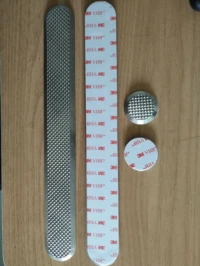
Hey there! As a supplier of tactile studs, I've seen firsthand how important these little guys are in making our environments safer and more accessible. In this blog, I'm going to dive into the regulations for tactile studs and why they're crucial for various settings.
So, what exactly are tactile studs? Tactile studs, also known as tactile indicators, are raised or textured surfaces installed on the ground to provide sensory cues for people with visual impairments. They help these individuals navigate public spaces, such as sidewalks, train stations, and airports, by indicating changes in direction, the presence of hazards, or the location of important facilities.
One of the key regulations for tactile studs is their design. Tactile studs come in different shapes and sizes, but they typically have either a domed or truncated cone shape. The domes or cones are arranged in a specific pattern to convey different messages. For example, a series of closely spaced domes may indicate a warning, while a more widely spaced pattern may signal a safe path.
The size of the tactile studs is also regulated. The domes or cones should be large enough to be easily felt by a person using a cane or walking barefoot. In most countries, the minimum diameter of the domes or cones is around 25mm, and the height is typically between 3mm and 6mm.
Another important aspect of tactile stud regulations is their color. Tactile studs are usually colored in a high-contrast color, such as yellow or black, to make them more visible to people with low vision. The color contrast helps these individuals distinguish the tactile studs from the surrounding surface and identify their location more easily.
In addition to design and color, the installation of tactile studs is also regulated. Tactile studs should be installed in a way that ensures they are firmly attached to the surface and do not pose a tripping hazard. They should also be installed at the correct height and alignment to provide accurate sensory cues.
The regulations for tactile studs vary from country to country, and even from state to state within a country. For example, in the United States, the Americans with Disabilities Act (ADA) sets standards for the design and installation of tactile studs in public buildings and facilities. These standards include requirements for the size, shape, color, and installation of tactile studs.
In Australia, the Building Code of Australia (BCA) and the Australian Standards for Tactile and Visual Indicators (AS 1428.4) provide guidelines for the use of tactile studs in buildings and public spaces. These guidelines cover aspects such as the design, installation, and maintenance of tactile studs.
As a supplier of tactile studs, it's important for me to stay up-to-date with the latest regulations and standards. I work closely with architects, designers, and contractors to ensure that the tactile studs I supply meet all the necessary requirements. This helps to ensure the safety and accessibility of the environments in which they are installed.
Now, let's take a closer look at some of the specific regulations for tactile studs in different settings.
Sidewalks and Pedestrian Crossings
Tactile studs are commonly used on sidewalks and pedestrian crossings to help people with visual impairments navigate safely. In many countries, it is mandatory to install tactile studs at the edges of sidewalks and at pedestrian crossings.
The tactile studs used on sidewalks and pedestrian crossings are typically of the truncated cone type. They are arranged in a specific pattern to indicate the direction of travel and the presence of a pedestrian crossing. For example, a series of closely spaced truncated cones may indicate the edge of a sidewalk, while a more widely spaced pattern may signal the start of a pedestrian crossing.
The color of the tactile studs used on sidewalks and pedestrian crossings is usually yellow or black. The high-contrast color helps to make the tactile studs more visible to people with low vision.
Train Stations and Airports
Tactile studs are also widely used in train stations and airports to help people with visual impairments navigate the complex environments. In these settings, tactile studs are used to indicate the location of platforms, stairs, escalators, and other important facilities.
The tactile studs used in train stations and airports are typically of the domed type. They are arranged in a specific pattern to provide clear and consistent sensory cues. For example, a series of closely spaced domes may indicate the edge of a platform, while a more widely spaced pattern may signal the location of a stairway.


The color of the tactile studs used in train stations and airports is usually yellow or black. The high-contrast color helps to make the tactile studs more visible to people with low vision.
Buildings and Public Facilities
Tactile studs are also used in buildings and public facilities to help people with visual impairments navigate the interior spaces. In these settings, tactile studs are used to indicate the location of exits, stairs, elevators, and other important facilities.
The tactile studs used in buildings and public facilities are typically of the truncated cone type. They are arranged in a specific pattern to provide clear and consistent sensory cues. For example, a series of closely spaced truncated cones may indicate the edge of a stairway, while a more widely spaced pattern may signal the location of an elevator.
The color of the tactile studs used in buildings and public facilities is usually yellow or black. The high-contrast color helps to make the tactile studs more visible to people with low vision.
In conclusion, the regulations for tactile studs are an important aspect of ensuring the safety and accessibility of our environments. By following these regulations, we can help to make it easier for people with visual impairments to navigate public spaces and buildings.
If you're in the market for tactile studs, I'd love to help. As a supplier, I offer a wide range of tactile studs, including Tactile Surface Indicators, Tactile Indicators Melbourne, Stainless Steel Tactile, Tactile Indicator Studs, and Tactile Studs Stainless Steel. All of my products are designed and manufactured to meet the highest quality standards and comply with all relevant regulations.
Whether you're an architect, designer, contractor, or facility manager, I can work with you to find the right tactile studs for your project. So, if you're interested in learning more or getting a quote, please don't hesitate to get in touch. I'm always happy to answer any questions you may have and help you make the right choice for your needs.
References
- Americans with Disabilities Act (ADA)
- Building Code of Australia (BCA)
- Australian Standards for Tactile and Visual Indicators (AS 1428.4)